❋
Make a direct therapy referral
in-person in North Vancouver, virtually across BC.
You've referred clients for anxiety therapy before, and it hasn't quite moved the needle. Here's why OCD might be the missing piece
If you’re a healthcare provider, educator, or allied professional looking for anxiety and OCD supports for the people you serve - welcome!
Collaborative, evidence-based therapy for your patients.OCD is often associated with contamination and visible compulsions, but many individuals experience less obvious presentations that can be easily missed in primary care.
This can include:
Intrusive thoughts related to harm, relationships, morality, or identity
Excessive doubt and inflated responsibility
Mental compulsions (e.g., rumination, reassurance-seeking, “figuring it out”)
Checking behaviours (including Google/research)
Avoidance and procrastination driven by anxiety
These patterns often follow an OCD cycle, even when compulsions are primarily internal:
intrusive thoughts → anxiety → compulsions → temporary relief → repeat.
Studies estimate that up to 50% of individuals with OCD experience significant delays in receiving a correct diagnosis — often because presentations are internal and don't fit the contamination stereotype. (Glazier et al., 2013. Journal of Anxiety Disorders.)
I have a particular interest and skill in identifying and working with these more subtle presentations, including “sneaky” compulsions, like rumination, that can maintain distress over time.
When anxiety, overthinking, and avoidance persist despite medical assessment, medication, and standard supports, evidence-based psychotherapy can help.
Cognitive and behavioural therapies — CBT, Acceptance and Commitment Therapy (ACT), and Exposure and Response Prevention (ERP) — are gold-standard approaches to treating anxiety and related disorders, including GAD and OCD.
❋ Understanding OCD (beyond contamination)Referring to an anxiety therapist who also specializes in OCD can make a meaningful difference in outcomes. OCD is often mistaken for generalized anxiety, especially when compulsions are mental (e.g., rumination, reassurance-seeking, reviewing). Without recognizing these patterns, treatment can unintentionally reinforce the cycle.
Research consistently shows that ERP produces meaningful symptom reduction in 60–80% of OCD cases, with effects that are sustained over time. (Olatunji et al., 2013. Clinical Psychology Review.) Anxiety treated with CBT alone, without ERP, shows substantially lower response rates when OCD is the primary driver.
An OCD-informed therapist is trained to identify these less visible compulsions and use evidence-based approaches like Exposure and Response Prevention (ERP) to target the root of the problem, helping clients reduce compulsive patterns, tolerate uncertainty, and make lasting change.
Why OCD expertise matters in anxiety treatment
❋
how does anxiety and OCD therapy work?

I provide evidence-based therapy for OCD and anxiety, primarily using Exposure and Response Prevention (ERP), along with CBT and ACT-informed strategies.
ERP is a structured, well-researched approach that helps people respond differently to intrusive thoughts and anxiety, rather than trying to eliminate them. In OCD and anxiety patterns, distress is often maintained by avoidance and compulsive behaviours (including mental rituals like rumination or reassurance-seeking). Treatment focuses on gradually reducing these patterns so symptoms become more manageable over time.
Sessions are collaborative, paced, and tailored to the individual. Clients are supported in gradually facing feared thoughts or situations in a structured way, with attention to readiness and tolerance for discomfort. The goal is improved functioning, reduced impairment from anxiety patterns, and greater flexibility in day-to-day life.
The focus of this work is not to eliminate intrusive thoughts, but to help clients change how they respond to them
Clinical fit
I specialize in working with children, adolescents, and young adults (ages 10–25), though I see clients across the lifespan.
Common referral presentations include:
OCD
Generalized anxiety with compulsive features
Perfectionism and self-doubt
Rumination and intrusive thoughts
Reassurance-seeking and checking behaviours
I am not a good fit for primary concerns related to trauma, eating disorders, or psychosis.
If you're a pediatrician or family physician: watch for reassurance-seeking that doesn't resolve, somatic complaints without a clear medical cause, or anxiety that hasn't responded to standard interventions. These can be signs of OCD rather than GAD.
If you're a dietitian or nutritional therapist: rigid, fear-driven food rules, intense distress at deviation from a plan, or health anxiety around eating and symptoms may warrant an OCD-informed referral alongside nutritional support.
If you're a therapist or other mental health provider: if a client's anxiety isn't responding to standard CBT or reassurance-based approaches, an OCD consultation may be helpful. I'm also available for peer consultation.
Collaborative Care
I value working collaboratively with referring providers and aim to support continuity of care.
With client consent, I can:
Provide brief progress updates (every 1–2 sessions as needed)
Offer collateral information to support diagnostic clarification
Coordinate care alongside medication management
Connect via phone or secure communication when helpful
My goal is to make collaboration straightforward, useful, and respectful of your time.
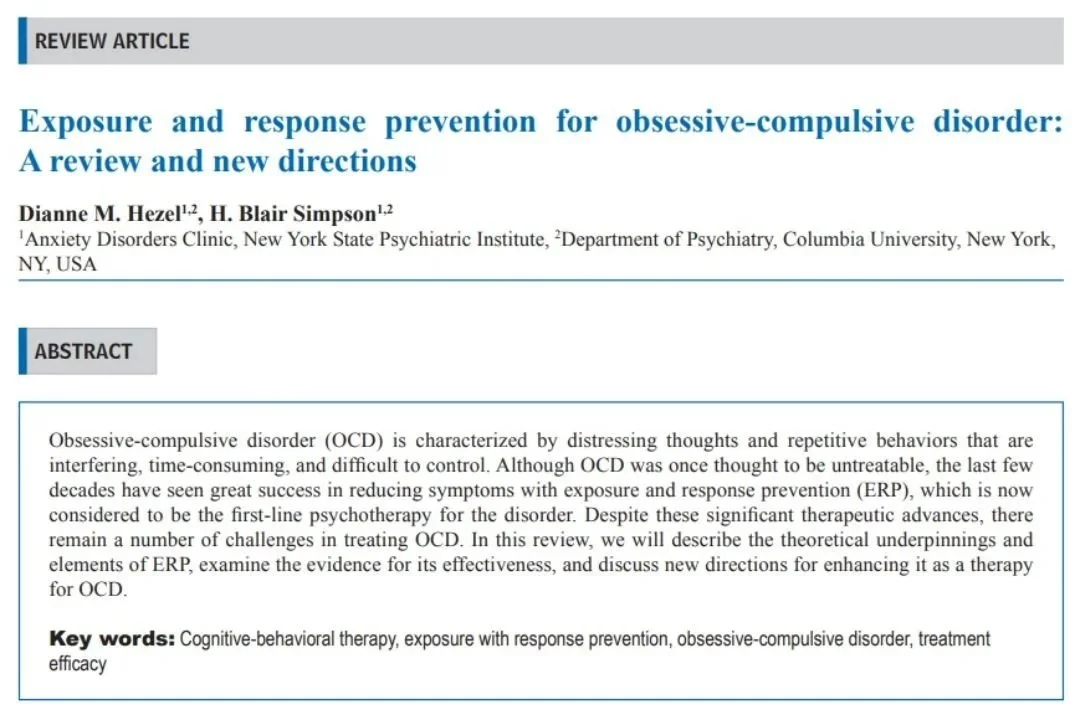
Further reading for providers

I highly recommend this thorough review!
ABOUT ALEXINA

I'm a Registered Clinical Counsellor (RCC) in North Vancouver, registered with the BC Association of Clinical Counsellors (BCACC). I specialize in OCD and anxiety in children, adolescents, and young adults (ages 10+).
My primary treatment modality is Exposure and Response Prevention (ERP) — the gold-standard, evidence-based treatment for OCD — alongside CBT, ACT, and DBT. I completed my Master of Counselling Psychology with a specialization in school and youth populations, and my clinical practicum at Foundry North Shore.
My approach is warm and collaborative. I take time to understand the full picture before introducing strategies, and I prioritize the therapeutic relationship throughout.
I'm particularly interested in the less visible presentations of OCD, the ones that are easy to miss in a time-pressured appointment, and in supporting practitioners who want a reliable, communicative colleague to refer to.
Referral Process
Referrals can be made in the following ways:
Submit a referral form via my website
Direct clients to self-book through JaneApp
I also offer a 15–20 minute consultation to ensure fit prior to starting therapy.
Wait time: Typically within 1 week
Format: In-person (North Vancouver) and virtual across BC
Fees & Coverage
Rate: $160/50-minute session.
Services are private pay and not covered by MSP.
Clients may be eligible for reimbursement through extended health benefits.
A limited number of sliding scale spaces are available ($100/50-minute session).
Get in Touch / Refer
You can refer a patient or learn more about my approach using the link below:

Frequently Asked Questions
-
Your client will receive a confirmation and be contacted to book a free 15–20 minute consultation to confirm fit. You're welcome to reach out directly if you'd like to share context first.
-
Yes, with client consent. I can provide brief progress updates every couple of sessions, or connect by phone when it would be helpful.
-
I'll let you know after the initial consultation and can suggest alternative resources where possible.
-
Typically within 1-2 weeks.
-
Yes. I'm happy to coordinate alongside medication management, nutritional support, school-based supports, or other allied health providers.